Critical Analysis of An Elementary School Classroom in a Slum
Stephen Spender’s poem An Elementary School Classroom in a Slum is not just a description of poor children sitting inside a classroom. It is a sharp social criticism of a world that speaks about education, equality and progress, but leaves millions of children trapped in poverty. The poem shows a classroom where children are physically present, but their future is almost absent. Their school is not a place of hope; it is a dark room where hunger, disease, neglect and social injustice silently sit beside them.
The beauty of the poem lies in its painful honesty. Spender does not romanticise poverty. He does not present poor children as symbols of simple innocence. Instead, he shows how poverty damages the body, weakens the mind and steals dreams before they can grow. The poem asks a serious question: what is the use of education if society does not give poor children the freedom, health and opportunity to use it?
The Classroom as a Symbol of Neglect
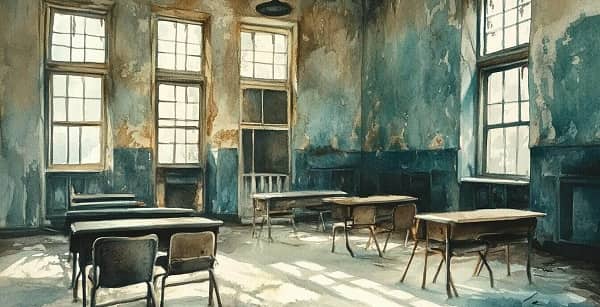
The classroom in the poem is not a lively place of learning. It is dull, cramped and lifeless. The children sit in a room that reflects their broken social condition. Their faces are pale, tired and withdrawn. They are not full of childhood energy. They look like children who have already carried the burden of life too early.
The classroom becomes a symbol of a failed system. A school is supposed to open the world for children. But here, the classroom only reminds them of their prison-like existence. The walls contain pictures, maps and educational materials, but these objects feel almost meaningless. They show a bright and beautiful world that the children cannot reach. In this way, the classroom becomes a place of cruel contrast: education promises freedom, but poverty keeps the children locked in misery.
Portrait of the Children
Spender’s description of the children is deeply disturbing. They are weak, sickly and undernourished. One child is described as having a “rat’s eyes,” suggesting fear, hunger and sharp survival instinct. Another child has inherited a disease from his father. This detail is important because it shows that poverty is not only a present problem; it passes from one generation to another.
The children are not responsible for their condition. They are born into a system that has already limited their lives. Their bodies carry the marks of social injustice. Their poor health, dull faces and lack of confidence show that they have been denied the basic needs of childhood: good food, clean surroundings, medical care, emotional safety and meaningful education.
Spender makes the reader feel that these children are not lazy or incapable. They are victims of an unequal world. Their potential exists, but it is buried under hunger and hopelessness.
The Irony of Education
One of the strongest elements in the poem is irony. The classroom has maps, pictures of Shakespeare and images of beautiful places. These things usually represent knowledge, culture and imagination. But for the slum children, they become symbols of exclusion.
The map shows cities, rivers, mountains and oceans. It suggests a wide world full of movement and possibility. But these children know only the narrow lanes of the slum. The map does not belong to them. It shows a world controlled by the rich and powerful. Similarly, Shakespeare represents high culture and intellectual beauty, but his presence on the wall seems almost useless in a classroom where children are hungry and hopeless.
This does not mean Spender is against Shakespeare or education. Rather, he is against empty education. He criticises a system that teaches poor children about a world they are never allowed to enter. Education without social justice becomes decoration, not transformation.
The Slum as a Trap
The slum in the poem is not only a physical place. It is a social trap. The children are surrounded by poverty from all sides. Their homes, streets and school all reflect the same lack of opportunity. Even if they sit in a classroom, their minds cannot easily escape the pressure of their environment.
Spender shows that poverty limits imagination. When life is filled with hunger, disease and struggle, dreaming becomes difficult. The children cannot freely think about nature, literature, science or travel because their daily reality is too harsh. The slum controls their vision. It teaches them smallness, fear and helplessness.
This is one of the poem’s most powerful ideas: poverty is not only a lack of money. It is a lack of space, health, beauty, confidence and future.
Use of Imagery and Language
The poem is rich in strong visual imagery. Spender uses dull, grey and unpleasant images to create the atmosphere of the classroom. The children are compared to rootless weeds, showing that they are unwanted and neglected by society. This comparison is painful because weeds grow without care, in poor conditions, and are often removed or ignored.
The language of the poem is serious and controlled. It does not use unnecessary emotion. Instead, the images themselves create sadness and anger. Words related to disease, darkness, narrowness and decay dominate the poem. Through this language, Spender makes the reader feel the suffocation of the slum.
At the same time, the poem also contains images of light, sun, fields and open spaces. These images represent freedom and hope. The contrast between darkness and light gives the poem its emotional power.
Social Inequality and Class Division
The poem is a criticism of class inequality. Spender shows that the world is divided between those who enjoy beauty, education and freedom, and those who are denied even basic dignity. The rich world exists on the classroom walls as pictures and maps, but the poor children remain outside it.
This division is not natural; it is created by society. The poem suggests that poverty continues because powerful people allow it to continue. The children are not personally weak; the system around them is unjust. Their classroom becomes evidence of this injustice.
The poem therefore moves beyond sympathy. It demands responsibility. It tells readers that feeling sad for poor children is not enough. Society must change the conditions that keep them poor.
The Poet’s Demand for Change
In the final part of the poem, Spender’s tone becomes more urgent. He says that the children must be taken out of this darkness. Their world must be connected with the sun, the sea, green fields and open spaces. These images represent real education, not just classroom teaching.
The poet wants these children to experience freedom. He wants education to become a living force in their lives. Books should not remain dead objects. Knowledge should help them break barriers. The classroom should not repeat poverty; it should help children defeat it.
Spender’s message is clear: the children need more than lessons. They need justice, health, opportunity and human respect.
Relevance of the Poem Today
The poem remains highly relevant even today. In many parts of the world, children still study in poor classrooms without proper facilities. Many students attend school while suffering from hunger, family pressure, disease or unsafe surroundings. The poem reminds us that simply building schools is not enough. Education must be supported by nutrition, healthcare, social security and equal opportunity.
The poem also warns us against decorative development. A country may speak proudly about progress, but if poor children are left behind, that progress is incomplete. True development begins when the weakest child gets a fair chance to grow.
Conclusion
An Elementary School Classroom in a Slum is a powerful poem because it exposes the difference between the promise of education and the reality of poverty. Stephen Spender turns a simple classroom scene into a deep criticism of social injustice. The children in the poem are not just students; they are symbols of millions of lives trapped by inequality.
The poem’s greatness lies in its moral force. It does not only ask us to look at poor children; it asks us to look at the system that has failed them. It reminds us that education becomes meaningful only when it opens doors. A classroom should not be a cage of broken dreams. It should be a window to light, dignity and freedom.